








Choosing the right calendar size is an important part of planning a successful custom calendar printing project. While a calendar may seem like a simple printed product, its dimensions can affect almost every aspect of the final result—from the amount of information you can include and the readability of your design to the available writing space, portability, packaging, and overall printing cost.
There is no single calendar size that works for every project. A large wall calendar may be ideal for showcasing artwork or photography, while a compact desk or pocket calendar may be more practical for everyday scheduling. Businesses may prefer a promotional calendar that balances useful planning space with an easy-to-mail format, while artists and photographers may focus on larger dimensions that allow their images to stand out.
Understanding common calendar sizes can help you make a more informed decision before preparing your artwork. It can also reduce the risk of having to redesign files after production specifications have been confirmed.
In this guide, we’ll explain common calendar sizes, and the key factors to consider when selecting the right dimensions for your project.
Why Selecting the Right Calendar Size Matters?
Calendar dimensions influence much more than the physical appearance of the finished product. The size you choose can affect your design, branding, usability, production requirements, and printing budget.
Design Layout
Calendar size directly affects your available design area.
A larger calendar provides more room for photographs, illustrations, promotional graphics, monthly grids, holidays, notes, and other information. This can be particularly useful when your calendar includes detailed artwork or requires generous writing space.
A smaller calendar, on the other hand, requires a more efficient layout. Text, dates, logos, and other elements need to be carefully arranged so that the finished calendar remains easy to read.
For example, an 11″ x 17″ wall calendar gives you significantly more visual space than a 5.5″ x 8.5″ calendar. If your project includes large photographs or detailed illustrations, choosing a larger format can help preserve image impact.
Size also influences the relationship between the image area and calendar grid. A design intended for a square format may not translate well to a rectangular calendar without cropping or rearranging the artwork.
For this reason, it is best to decide on the calendar dimensions before creating the final artwork.
Brand
Calendar size can also influence how your brand is perceived.
For corporate calendars, promotional calendars, and branded gifts, the physical format should match the intended brand image. A premium company calendar may benefit from a larger format with high-quality images and generous white space, while a practical promotional calendar may work better in a compact and economical size.
The calendar format can also affect how prominently your logo, contact information, website, product images, or promotional messages appear.
A large wall calendar gives your brand more visible space and can remain on a customer’s wall throughout the year. A small desk or pocket calendar may provide more portability and allow customers to carry your branding with them.
The goal is not necessarily to choose the largest available size. Instead, select a format that supports your brand identity and the way your audience will use the calendar.
Printing Cost
Calendar size can have a direct impact on production cost.
Larger calendars generally require more paper or board and may require larger printing sheets, packaging, and shipping cartons. They can therefore cost more to manufacture and transport.
However, size is only one factor affecting the final price. Paper stock, page count, printing method, binding, finishing, quantity, packaging, and shipping method can also influence the total cost.
For larger quantities, selecting an efficient standard format may help reduce paper waste and production expenses. If you are printing promotional calendars for a large customer base, a smaller or medium-sized format may provide a better balance between usability and cost.
For premium calendars, however, the additional cost of a larger format may be worthwhile if it improves the visual presentation and perceived value of the product.
What’s the Standard Calendar Size?

There is no universal standard calendar size for every calendar format or market. However, 8.5″ x 11″ is one of the most familiar and practical standard calendar sizes, particularly for printed calendars in North America. For a calendar that opens flat, an 8.5″ x 11″ closed format can provide an 11″ x 17″ spread when opened, offering a larger viewing area for artwork, photographs, calendar grids, and other content.
The 8.5″ x 11″ format is commonly used because it provides a convenient balance between readability, writing space, portability, and production efficiency. When opened to 11″ x 17″, it provides even more space for displaying monthly information and visual content without requiring an oversized finished product when closed.
That said, the best calendar size depends on the specific format and purpose of your project. Wall calendars, desk calendars, poster calendars, desk pads, magnetic calendars, and pocket calendars all have different size requirements.
When planning a custom calendar, it is therefore more useful to think of 8.5″ x 11″ as a common standard calendar size rather than a universal rule.
Typical Calendar Sizes
Different calendar formats are designed for different environments and use cases. Below are some common dimensions to consider.
Wall Calendar:
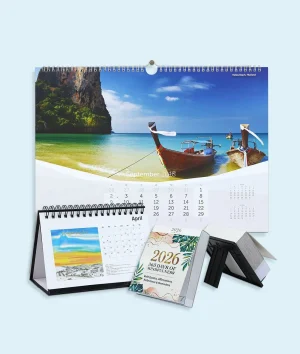
Wall calendars are among the most popular custom calendar formats. They are designed to be displayed vertically or horizontally on a wall and typically provide enough space for dates, notes, artwork, photographs, or branding.
8.5″ x 11″ is a practical medium-sized format suitable for general-purpose calendars, promotional products, offices, and homes.
11″ x 17″ provides substantially more visual space and is a good option for photography calendars, artwork calendars, and projects that need larger monthly grids.
12″ x 12″ offers a square format that works particularly well with photography, illustration, and graphic designs. The square proportions can create a balanced visual presentation while giving each month a dedicated display area.
5.5″ x 8.5″ is a compact wall-calendar format suitable when wall space is limited or portability and economical production are priorities.
9″ x 12″ provides a slightly larger rectangular format while remaining relatively easy to display in homes, offices, classrooms, and other spaces.
When choosing a wall calendar size, consider both the wall area available and the viewing distance. A larger calendar is generally easier to read from across a room, while a compact calendar may be more suitable for a small workspace.

Desk Calendar:
Desk calendars are designed to sit on a desk, countertop, reception area, shelf, or other flat surface. Their compact size makes them especially useful for offices and personal workspaces.
5.5″ x 8.5″ provides a comfortable balance between calendar visibility and desk space.
5″ x 7″ is a compact format that can work well for promotional calendars, photography projects, and everyday scheduling.
6″ x 8″ offers additional room for dates and images while maintaining a relatively small footprint.
10″ x 4.5″ is a wide, horizontal format that can work particularly well as a desktop planning calendar. Its elongated shape can provide useful horizontal writing space without taking up excessive desk depth.
6″ x 6″ creates a compact square format suitable for creative designs, photography, branding, and modern desktop calendars.
When choosing a desk calendar size, remember that the calendar needs to fit not only the available desk space but also the area required for its stand or binding.

Poster Calendar:
Poster calendars focus on visibility and large-scale presentation.
8.5″ x 11″ is a relatively compact poster-calendar option and can be used in smaller spaces.
11″ x 17″ offers a larger display area and works well for offices, classrooms, studios, retail environments, and promotional applications.
18″ x 24″ provides a significantly larger canvas for large-format calendar designs. This format is especially suitable for artwork, photography, educational calendars, event planning, and projects where visibility is more important than portability.
Large poster calendars can also provide ample room for branding, promotional messages, illustrations, and detailed date information.

Desk Pad Calendar:
A 22″ x 17″ desk pad calendar provides a large planning surface designed to sit directly on a desk or worktable.
Because of its generous dimensions, this format is particularly useful for businesses, offices, students, designers, project managers, and anyone who needs substantial space for appointments, deadlines, tasks, or notes.
The larger surface also provides more room for branding and customized layouts.
When producing desk pad calendars, consider the paper weight and binding or adhesive method carefully. The finished product should be easy to write on while remaining durable enough for frequent use.

Magnetic Calendar:
Magnetic calendars are designed to attach to refrigerators, filing cabinets, whiteboards, lockers, and other metal surfaces.
2″ x 3.5″ is a highly compact format suitable for simple calendars, promotional giveaways, and reminders.
4″ x 6″ provides more room for dates, logos, contact information, and promotional messaging.
4″ x 8″ offers a wider layout and additional space for scheduling or branding.
Because magnetic calendars are often used as promotional products, compact sizes can be particularly attractive for businesses. They are easy to distribute, inexpensive to store, and convenient for customers to keep in visible locations.

Pocket Calendar:
A 3.5″ x 6″ pocket calendar is designed for portability.
Its compact dimensions make it easy to carry in a wallet, purse, backpack, notebook, or pocket. Pocket calendars are often used for promotional purposes because they provide a practical product that customers can use throughout the year.
Since the available space is limited, the design should focus on readability. Avoid using excessively small text or overcrowding each page with unnecessary information.
A pocket calendar can also be a useful format for travel businesses, financial services, healthcare organizations, retailers, restaurants, schools, and other businesses looking for a compact promotional product.
Calendar Sizes by Binding

The binding method can also influence which calendar dimensions are practical for your project. Different binding styles provide different levels of flexibility, durability, and presentation.
Saddle Stitch:
Saddle stitching is a cost-effective binding method commonly used for calendars made from folded pages.
Typical saddle-stitched calendar sizes include:
5.5″ x 8.5″: The 5.5″ x 8.5″ format is compact and economical, making it suitable for smaller calendars and promotional applications.
8.5″ x 8.5″: The 8.5″ x 8.5″ square format provides a creative presentation for photography and artwork.
8.5″ x 11″: The 8.5″ x 11″ format is a versatile option for general-purpose calendars and promotional projects.
Saddle stitching works especially well for relatively thin calendar formats. The pages are folded and secured along the spine using staples.
Because saddle-stitched calendars are folded during production, artwork should be prepared with appropriate margins and bleed according to your printer’s specifications.
Wire-O Calendar:
Wire-O binding is a popular choice for calendars because it allows pages to turn smoothly and lay flat when opened, making it convenient for everyday use. It is suitable for both compact desk calendars and larger wall calendars.
Common Wire-O calendar sizes include:
6″ x 6″: A compact square format that works well for desks, countertops, and other small display areas.
5.5″ x 8.5″: A compact rectangular format that offers a good balance of portability, readability, and writing space.
8.5″ x 11″: A versatile standard-size format that provides ample room for calendar grids, images, notes, and branding.
12″ x 12″: A large square format that provides plenty of space for photography, artwork, and premium calendar designs.
11″ x 17″: A larger format that offers excellent visibility and ample space for detailed artwork, photographs, and easy-to-read calendar grids.
Wire-O calendars are particularly suitable for projects that require frequent page turning throughout the year. The binding also provides a clean, professional appearance and allows the calendar to open conveniently for display.
When preparing artwork for a Wire-O calendar, be sure to leave enough space along the binding edge for punching and wire binding. This helps prevent important text, images, or design elements from being too close to the binding area.
Perfect Binding with Stand:
Perfect binding with a stand is a compact and visually distinctive format commonly used for desktop tear-off calendars.
Typical sizes include:
4.25″ x 4.25″
4.5″ x 4.5″
These small square formats are designed to sit upright on a desk or other flat surface. They are particularly suitable for minimalist designs, small photography calendars, promotional products, and gift calendars.
Because the available design area is limited, typography and layout need to be carefully considered. The compact format works best when the design is clean and information is presented clearly.
Vertical vs. Horizontal Calendar

Calendar orientation is another important decision that should be made alongside size.
A vertical calendar is taller than it is wide. This format works well for portrait photography, illustrations, individual monthly images, and layouts where the calendar grid is positioned below or beside a vertical image.
A horizontal calendar is wider than it is tall. It can be useful for landscape photography, panoramic artwork, long planning schedules, and layouts that require more horizontal writing space.
For example, an 11″ x 17″ calendar can be designed vertically or horizontally depending on the intended layout. The physical dimensions alone do not determine the orientation; your artwork and production specifications need to define how the calendar will be displayed.
When choosing between vertical and horizontal formats, consider the content first.
If your project features portrait photographs, people, buildings, or vertical illustrations, a vertical layout may be more natural.
If your project features landscapes, panoramic images, group scenes, or wide illustrations, a horizontal layout may provide a better visual composition.
You should also consider the available wall or desk space. A horizontal calendar may work better above a desk, while a vertical calendar may fit more naturally on a narrow wall.
How to Choose the Right Calendar Size
Choosing the right calendar size becomes easier when you check your project from several practical perspectives.
Purpose
Start by identifying what the calendar is primarily intended to do.
Is it a promotional giveaway, corporate gift, retail product, art calendar, photography calendar, personal planner, or everyday scheduling tool?
For promotional calendars, compact and cost-efficient formats such as 5″ x 7″ or 8.5″ x 11″ may be practical.
For photography and artwork calendars, larger formats such as 11″ x 17″ or 12″ x 12″ can provide greater visual impact.
For personal planning, a desk pad or larger desk calendar may be more useful because it provides additional writing space.
The purpose should be the first consideration because it determines how the calendar will actually be used.
Design
Consider the content of your artwork before selecting the final dimensions.
Count how many images, text elements, logos, calendar grids, notes, illustrations, and other design elements need to fit on each page.
If your design contains detailed information, a larger format may make it easier to maintain comfortable text sizes and adequate spacing.
If your artwork is minimalist, a smaller format may be enough.
Also consider image proportions. If your photographs are predominantly square, a square calendar such as 12″ x 12″ may work well. If your photographs are primarily landscape or portrait oriented, select a calendar format that complements those proportions.
Choosing the size after the artwork has already been designed can lead to unnecessary cropping and layout adjustments.
Available Space
Measure the area where the finished calendar will be displayed.
For wall calendars, consider the available wall width and height. A large 18″ x 24″ poster calendar may look impressive in a spacious office but may be impractical for a small home workspace.
For desk calendars, measure the available desk area and consider whether other objects will compete for space.
Remember to account for the physical space occupied by stands, wire binding, hanging loops, or other components.
A calendar should be large enough to be useful but not so large that it becomes inconvenient to display.
Writing Space
If users need to write appointments, reminders, deadlines, or notes on the calendar, writing space becomes especially important.
A beautiful calendar with insufficient space for writing may be less useful in everyday life.
Larger formats generally provide more room for handwritten notes. Desk pad calendars are particularly suitable for users who need extensive planning space.
For smaller calendars, consider whether each day needs individual writing space or whether a simplified monthly layout would be more appropriate.
You should also consider the paper surface. If users will write on the calendar frequently, choose a paper stock and finish that supports pens and pencils appropriately.
Portability
Think about whether the calendar needs to be carried from one location to another.
Pocket calendars and compact desk calendars are much easier to transport than large wall or poster calendars.
If your calendar is intended as a promotional giveaway for trade shows, conferences, retail stores, or direct-mail campaigns, portability can be an important consideration.
Compact formats also generally require less packaging space and may be easier and less expensive to ship.
Budget
Finally, consider your production budget.
Larger calendars may require more paper, larger packaging, and additional shipping space. Premium binding and finishing can also increase production costs.
If you need to print thousands of calendars, even a small difference in unit cost can have a significant impact on the total project budget.
For budget-sensitive projects, consider using a commonly produced size and an efficient binding method. For premium retail or corporate calendars, investing in a larger format, heavier paper, specialty finishes, or upgraded binding may provide additional perceived value.
The key is to balance cost with the intended quality and purpose of the calendar.
How Calendar Size Affects Your Artwork

Before creating print-ready artwork, make sure the final calendar size has been confirmed with your printer.
Different calendar sizes require different document dimensions, bleed areas, safe zones, and binding allowances.
For example, an 8.5″ x 11″ calendar file should not simply be resized from a 12″ x 12″ design without checking the image proportions. Resizing can change the composition, crop photographs, alter text placement, and create unwanted white space.
For professional printing, artwork should normally include bleed beyond the final trim size. Important text and logos should remain within the safe area so they are not too close to the trim edge or binding.
When preparing calendar artwork, consider the binding method as well. Wire-O calendars need extra space along the binding edge for punching, while saddle-stitched calendars require a page count in multiples of four for proper folding and assembly.
If you are unsure about the correct file setup, ask your calendar printer for a template before starting the final design.
Choosing Calendar Size for Different Projects
Different customers may benefit from different formats.
For businesses: 8.5″ x 11″ or 11″ x 17″ calendars offer a good balance between branding, usability, and visibility.
For photographers: 11″ x 17″ and 12″ x 12″ formats provide larger areas for high-quality images.
For artists: Square or large-format calendars can provide an effective canvas for illustrations and artwork.
For promotional campaigns: Smaller desk, magnetic, poster, or pocket calendars can be economical and easy to distribute.
For offices: Desk calendars and desk pads provide convenient scheduling and writing space.
For classrooms and educational projects: Larger poster calendars can make dates and information easier to see from a distance.
For personal gifts: Compact desk calendars, square calendars, or premium wall calendars can be selected based on the recipient and available display space.
There is no universally perfect calendar size. The best format is the one that supports your project’s purpose, design, audience, and budget.
Calendar Printing Services
Choosing the right dimensions is only one part of creating a successful custom calendar. You also need a printing partner that can support your preferred size, binding, paper, finishing, and packaging requirements.
BookPrintingChina provides custom calendar printing services for brands, publishers, businesses, artists, photographers, designers, creators, and personal projects. We can help turn your calendar concept into a professionally printed product with customizable sizes, layouts, paper stocks, binding options, and finishing.
Whether you need a compact desk calendar, a promotional wall calendar, a large poster calendar, a desk pad calendar, or a premium custom calendar, we can provide flexible printing solutions to meet your project requirements.
Our services include custom templates and free file checking to help you prepare print-ready artwork. We can review your files for common production issues and help ensure that the dimensions, bleed, margins, resolution, and other specifications are suitable for printing.
If you already have a preferred calendar size, our team can help confirm the appropriate production specifications before you finalize your artwork.